
Asbestos is defined as a group of naturally occurring silicate minerals used extensively in Australian building materials until its complete ban in 2003, meaning millions of homes built before that date still contain it today. The asbestos risks in older Australian homes are real but manageable. Fibres only become dangerous when materials are disturbed, damaged, or deteriorated, releasing microscopic particles into the air. Cancer Council Australia and Victorian health departments both confirm that undisturbed asbestos in good condition poses a low risk. The moment you drill, sand, or cut into asbestos-containing material, the risk changes entirely.
1. Where asbestos hides in older Australian homes
Asbestos-containing materials (ACMs) appear in more locations than most homeowners expect. Knowing where to look is the first step in managing old homes asbestos safely.
Exterior locations:
- Fibro (fibrous cement) wall cladding and eaves lining
- Corrugated asbestos roofing sheets
- Fencing panels, particularly in homes built in the 1960s and 1970s
- Flue pipes on wood heaters and gas appliances
- Guttering and downpipes on some older properties
Interior locations:
- Wall and ceiling sheeting, including textured “popcorn” ceilings
- Vinyl floor tiles and their adhesive backing
- Pipe lagging and duct insulation
- Loose-fill insulation, known as “Mr Fluffy,” in roof cavities
The Mr Fluffy loose-fill insulation is among the most dangerous forms because it is friable, meaning it crumbles and releases fibres easily. If you suspect your roof cavity contains it, do not enter. Contact a licensed asbestos assessor immediately.
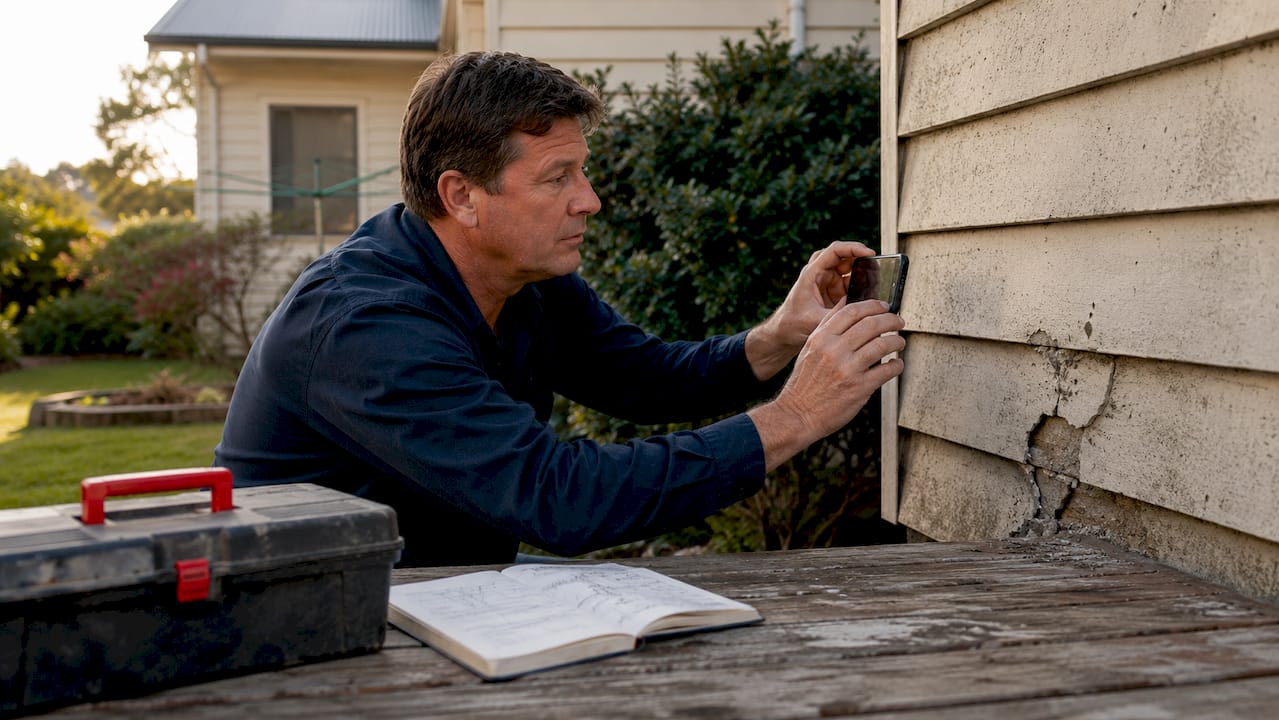
Pro Tip: Before any renovation work, photograph every suspect material and have a certified inspector test samples. Visual identification alone is not reliable.
2. Understanding the health risks from asbestos exposure
Asbestos exposure causes mesothelioma, lung cancer, ovarian cancer, and laryngeal cancer, with symptoms emerging decades after the original exposure. That delay is what makes asbestos exposure dangers so deceptive. A homeowner who disturbs ACMs during a weekend renovation may not see health consequences for 20 or 30 years.
“The risk of developing an asbestos-related disease depends on the amount of asbestos fibres inhaled, the duration of exposure, the frequency of exposure, and the type and size of fibres.” — Cancer Council Australia
Four factors determine how serious any exposure event is:
- Fibre type: Amphibole fibres (blue and brown asbestos) are more hazardous than chrysotile (white asbestos).
- Fibre quantity: Higher concentrations in the air mean greater risk.
- Duration: A single brief exposure carries far less risk than repeated long exposures.
- Material condition: Friable asbestos releases far more fibres than non-friable ACMs.
Cancer Council Australia confirms that risk arises from airborne fibres, not simply from the presence of asbestos material. An intact, sealed fibro wall sheet poses minimal risk. The same sheet, sanded or broken, becomes a serious hazard.
3. How to identify asbestos in your home
Identifying asbestos accurately requires laboratory testing. No visual inspection, regardless of experience, can confirm the presence of asbestos with certainty.
The standard asbestos inspection process involves a licensed assessor collecting small samples from suspect materials, sealing them, and sending them to an accredited laboratory for analysis. Results typically confirm whether chrysotile, amosite, or crocidolite fibres are present.
Homes built before 1990 are the primary concern. Asbestos was used widely in Australian construction from the 1940s through to the mid-1980s, and some products remained in use until the 2003 ban. If your home was built or renovated during that period, treat any fibrous cement, textured ceiling, or vinyl tile as a potential ACM until tested.
Pro Tip: Use a certified asbestos testing service rather than a DIY test kit. Accredited laboratories provide legally defensible results that matter when selling or renovating.
4. Asbestos safety guidelines every homeowner must follow
The national guide Asbestos: a guide for householders and the general public, endorsed by the Australian Health Protection Principal Committee, sets the standard for safe asbestos management in residential settings. Following it is not optional if you want to protect your household.
The core rules are straightforward:
- Do not disturb intact ACMs. If the material is sealed, in good condition, and not in a location where it will be damaged, leave it alone.
- Never sand, grind, drill, or cut ACMs. These actions release the highest concentrations of fibres.
- Isolate any damaged area immediately. If a storm, fire, or accident damages ACMs, restrict access and contact professionals. Do not attempt cleanup yourself.
- Check your state’s DIY limits. Victoria, for example, permits homeowners to remove up to 10 square metres of non-friable asbestos themselves under specific conditions. Friable asbestos always requires a licensed removalist.
- Hire a licensed asbestos removalist for any removal work. Find licensed contractors through your state’s workplace health and safety authority or through services like licensed asbestos removalists.
- Never place asbestos waste in general bins. Asbestos waste requires double-bagging, labelling, and disposal at an approved facility.
Pro Tip: Contact your local council before disposal. Most councils have designated drop-off points or collection services for asbestos waste from residential properties.
5. Comparing your options: leave it, encapsulate it, or remove it
When you discover ACMs in your home, three management paths exist. Each suits different circumstances.
| Option | Best suited for | Key advantage | Key limitation |
|---|---|---|---|
| Leave undisturbed | Intact, sealed ACMs not near renovation work | No cost, no fibre release | Not suitable if renovation will disturb the area |
| Encapsulation | ACMs in fair condition, not heavily damaged | Lower cost than removal, reduces fibre release | Temporary solution; material still present |
| Professional removal | Damaged ACMs, renovation zones, or sale preparation | Permanent solution, full compliance | Higher upfront cost |
Leaving intact asbestos undisturbed is the preferred approach when materials are sealed and in good condition. Queensland Government guidance frames this as a “pause-and-assess” principle: before any intrusive work, stop and confirm whether ACMs are present and whether the work will disturb them.
Encapsulation involves applying a sealant or membrane over the ACM surface to prevent fibre release. It suits materials that are slightly weathered but structurally sound. Learn more about this method through a guide to asbestos encapsulation before deciding if it fits your situation.
Removal by a licensed professional is the only permanent solution. It is the right choice when ACMs are in a renovation zone, when materials are heavily damaged, or when you are preparing to sell. The cost is higher, but it eliminates ongoing management obligations.
6. Renovation compliance: what you must do before work starts
Renovating an older home with potential ACMs requires a structured approach. Thorough identification before any intrusive work is the single most effective way to prevent accidental fibre release.
Step-by-step compliance checklist:
- Commission an asbestos inspection before any demolition, drilling, or structural work begins.
- Obtain a written asbestos register identifying all ACMs, their condition, and their location.
- Plan your renovation around ACMs. Redesign where possible to avoid disturbing them.
- Engage a licensed removalist if the renovation cannot avoid ACMs.
- Consider air quality monitoring during removal work. This is particularly relevant for friable asbestos removal. Missiondemolition provides guidance on air monitoring for asbestos as part of safe removal projects.
- Comply with notification requirements. In NSW, removal of more than 10 square metres of non-friable asbestos requires notifying SafeWork NSW. Review the NSW asbestos removal regulations for current thresholds and obligations.
- Dispose of waste legally. Double-bag all ACM waste in heavy-duty plastic, label it clearly, and take it to an approved facility.
| State | DIY non-friable limit | Friable asbestos | Notification required |
|---|---|---|---|
| NSW | Up to 10 m² | Licensed removalist only | Yes, above 10 m² |
| Victoria | Up to 10 m² | Licensed removalist only | Check local council |
| Queensland | Homeowner permitted for minor work | Licensed removalist only | Varies by scope |
Several Australian states are actively harmonising their asbestos safety approaches, with Victoria referencing the national guide endorsed by enHealth and the Australian Health Protection Principal Committee to give homeowners consistent advice across jurisdictions.
Key takeaways
Asbestos in older Australian homes poses serious health risks only when fibres become airborne, making identification, careful management, and professional removal the three pillars of safe practice.
| Point | Details |
|---|---|
| Identify before you renovate | Commission a certified inspection before any drilling, cutting, or demolition work begins. |
| Intact ACMs are low risk | Sealed, undisturbed asbestos-containing materials are unlikely to cause harm if left alone. |
| Friable asbestos is high hazard | Mr Fluffy loose-fill and other friable materials require immediate professional assessment. |
| State rules vary | NSW, Victoria, and Queensland each set different DIY limits; check your state before starting work. |
| Removal is the only permanent fix | Encapsulation manages risk temporarily; licensed removal eliminates it for good. |
What I’ve learned after years of asbestos work on older Australian homes
Most homeowners I speak with underestimate one thing: how often asbestos turns up where nobody expected it. A bathroom renovation reveals vinyl tile adhesive. A kitchen update exposes textured ceiling sheeting. A new fence line uncovers old fibro panels buried just below the soil. The surprises are not rare. They are routine.
The biggest misconception I encounter is that asbestos is only a problem in “obviously old” homes. I have seen ACMs in properties renovated as recently as the early 1990s, because builders used up existing stock after the phase-out began. If your home was touched by a tradesperson before 2003, assume asbestos is possible until testing proves otherwise.
Cost is the other sticking point. Homeowners sometimes delay inspections or choose encapsulation when removal is the right call, purely to save money upfront. That calculation rarely holds. Asbestos diseases have a latency of decades, which means the consequences of a poor decision today may not appear until it is far too late to connect cause and effect. The cost of a proper inspection and licensed removal is modest compared to the alternative.
My honest advice: get the inspection done before you plan the renovation, not after you have already started. Stopping work mid-project to manage an unexpected ACM find is far more expensive than building the inspection into your planning from the start.
— Tarek
Safe asbestos removal for your older home
Missiondemolition provides fully licensed asbestos removal and residential demolition services across Sydney and wider NSW, with a team that follows every current safety regulation and environmental requirement. Whether you have identified a suspect material or need a full pre-renovation asbestos assessment, Missiondemolition handles the process from inspection through to legal disposal. Their team is available 24/7, carries full insurance, and works to SafeWork NSW standards on every project. For homeowners ready to act, asbestos removal in Sydney is available with transparent pricing and no obligation quotes.
FAQ
What year did Australia ban asbestos?
Australia completely banned asbestos in 2003. Homes built or renovated before that date may still contain asbestos-containing materials.
Is asbestos dangerous if I don’t touch it?
Intact, sealed asbestos in good condition is unlikely to pose a health risk. Risk increases significantly when materials are disturbed, damaged, or deteriorated.
Can I remove asbestos myself in Australia?
Most states permit homeowners to remove up to 10 square metres of non-friable asbestos under specific conditions. Friable asbestos always requires a licensed removalist, and NSW requires notification to SafeWork NSW for larger jobs.
How do I know if my home contains asbestos?
Visual inspection alone cannot confirm asbestos. A certified inspector must collect samples and have them tested at an accredited laboratory. Homes built before 1990 carry the highest likelihood of containing ACMs.
What cancers does asbestos cause?
Asbestos exposure causes mesothelioma, lung cancer, ovarian cancer, and laryngeal cancer. Symptoms typically appear decades after the original exposure, which is why preventive action during renovations matters so much.