
Identifying asbestos in a commercial building requires licensed surveys and laboratory testing. Visual inspection alone cannot confirm asbestos presence, and no property manager or business owner should rely on appearance to make that call. Under Australian work health and safety law, and aligned with international standards like EPA NESHAP, a formal asbestos survey is mandatory before any renovation or demolition work begins. Getting this wrong exposes workers to serious health risks and exposes you to significant legal liability.
How to identify asbestos in commercial buildings
The industry term for what most people call “asbestos identification” is an asbestos survey, and it has two distinct forms: a management survey and a demolition or refurbishment survey. Both require a licensed asbestos assessor. Neither can be replaced by a visual walkthrough, no matter how experienced the person conducting it.
Visual identification is fundamentally unreliable because asbestos-containing materials (ACMs) were engineered to look identical to non-asbestos alternatives. A 9×9 inch floor tile containing chrysotile looks exactly like one that does not. The only way to confirm asbestos presence is through bulk sample collection and laboratory analysis using Polarised Light Microscopy (PLM).

This matters for compliance. Under NSW Work Health and Safety Regulations, any workplace with a structure that may contain asbestos must have an asbestos register. That register must be based on a proper survey, not assumptions.
Why do commercial buildings contain asbestos?
Properties built or renovated before 1985 are high-risk for asbestos, with an estimated 20% of all buildings historically containing it. That figure represents an enormous portion of Australia’s commercial building stock. Warehouses, office blocks, schools, hospitals, and retail centres built during this era routinely incorporated asbestos for its fire resistance, durability, and low cost.
Types of asbestos found in commercial buildings
Three main types of asbestos appear in commercial construction:
- Chrysotile (white asbestos): The most common type, found in roof sheeting, floor tiles, pipe lagging, and cement products.
- Amosite (brown asbestos): Used heavily in thermal insulation, ceiling tiles, and fire protection boards.
- Crocidolite (blue asbestos): The most hazardous type, used in spray-on fireproofing and pipe insulation.
Common asbestos-containing materials in commercial properties
Asbestos-containing materials in commercial properties span a wide range of building components:
- Corrugated cement roof sheeting and wall cladding
- Vinyl floor tiles and the adhesive beneath them
- Textured ceiling coatings and acoustic tiles
- Pipe and duct insulation
- Fire doors and fire-rated partitions
- Electrical switchboard backing panels
- Expansion joints in concrete structures
Undisturbed asbestos in good condition poses little immediate risk to occupants. The danger arises when materials are drilled, cut, sanded, or demolished, releasing microscopic fibres into the air. Mesothelioma, asbestosis, and lung cancer are all linked to fibre inhalation, and there is no safe level of exposure.
Why can’t you identify asbestos by looking at it?
The core problem is that ACMs were designed to visually match non-asbestos materials. Spray-on fireproofing, insulation batts, and cement sheets with and without asbestos are indistinguishable to the naked eye. Even experienced tradespeople cannot tell the difference reliably.
An intrusive asbestos survey is mandatory before demolition or renovation under EPA NESHAP (40 CFR Part 61, Subpart M), and Australian regulations mirror this requirement. This means physically accessing concealed spaces, lifting floor coverings, and collecting bulk samples from suspect materials.
“Independent, conflict-free assessments are vital for credible surveys accepted by local authorities.” — Teton Environmental
The inspector must be licensed and independent. Hiring a company that also performs removal work creates a conflict of interest. Their financial incentive is to find asbestos, which undermines the credibility of the survey result.
Pro Tip: Request a copy of the inspector’s asbestos assessor licence before they set foot on site. In NSW, Class A and Class B licences cover different scopes of work. Confirm the licence class matches the survey type you need.
Standard PLM laboratory analysis carries a typical turnaround of 3–7 business days. Expedited options are available when project timelines are tight. Always use a NATA-accredited laboratory for results that will hold up to regulatory scrutiny.
How to prepare and conduct an asbestos survey
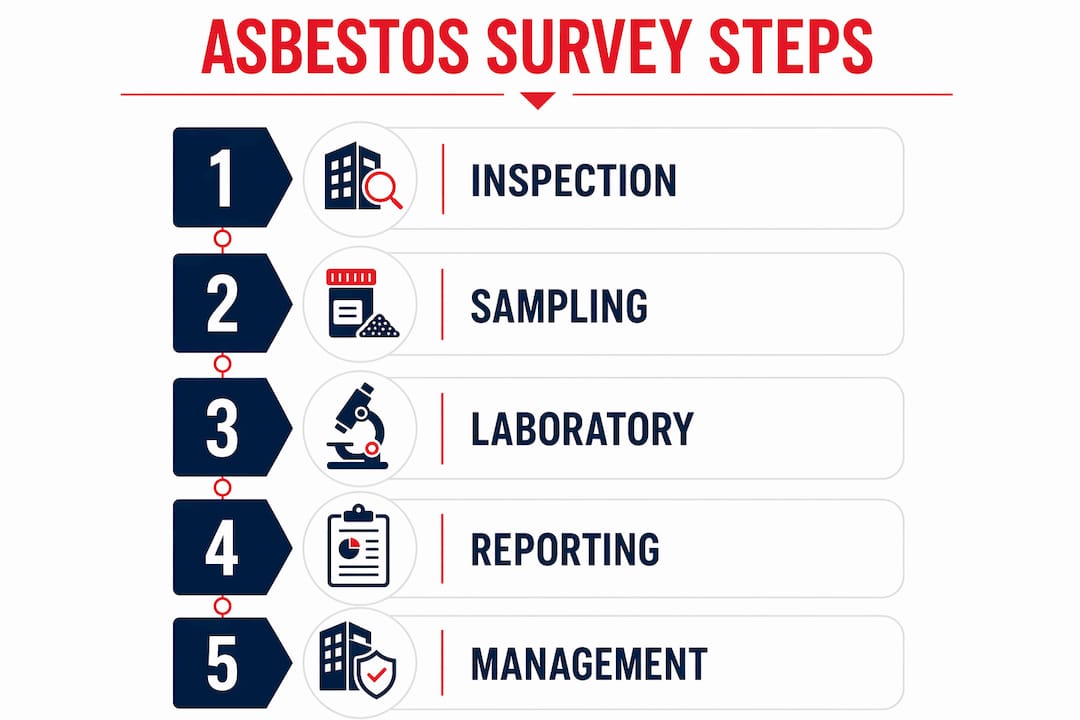
A thorough survey follows a clear sequence. Skipping steps creates gaps that can invalidate the entire process.
- Define the scope. Identify every building area that may be disturbed, including roof voids, wall cavities, subfloor spaces, and plant rooms. Concealed spaces are where surveys most often fall short.
- Engage a licensed, independent assessor. Hiring contractors who also perform removals for initial inspections is discouraged due to conflict of interest risks. Use a separate, accredited firm.
- Select the correct survey type. A management survey identifies ACMs that could be disturbed during normal building use. A demolition or refurbishment survey is more intrusive and required before any structural work.
- Allow full access. The assessor needs to open ceilings, lift tiles, and probe wall linings. Restricting access produces an incomplete survey and a register that will not satisfy regulators.
- Collect bulk samples to the required standard. EPA NESHAP requires at least three bulk samples per homogeneous material area, with five or more recommended for areas larger than 1,000 square feet. Homogeneous areas are sections of material that look the same and were installed at the same time.
- Submit samples to a NATA-accredited lab. PLM is the standard method. For materials near the detection threshold, point counting analysis detects asbestos down to 0.25%, compared to the 1% detection limit of standard PLM visual estimation.
- Compile the asbestos register. Document every suspect material, its location, condition, and lab result. This register is a legal document.
Survey type comparison
| Survey Type | When Required | Scope |
|---|---|---|
| Management Survey | Ongoing building occupation | Non-intrusive; identifies accessible ACMs |
| Demolition/Refurbishment Survey | Before any structural work or demolition | Intrusive; accesses concealed spaces |
Pro Tip: Define your homogeneous material areas carefully before sampling begins. One positive result in a defined area means the entire area is treated as ACM. Smaller, well-defined areas can limit the scope of required remediation.
How to interpret asbestos testing results
Lab reports classify each sample as positive or negative for asbestos. The classification threshold in Australia is greater than 0.1% asbestos by weight for some regulatory contexts, though the practical standard used by most labs is 1% by PLM unless point counting is requested.
If any single bulk sample tests positive within a homogeneous material group, the entire area is legally classified as an ACM. This is the rule that catches most property managers off guard. You cannot average results across samples or treat one positive as an outlier.
ACM management options
| Material Condition | Risk Level | Recommended Action |
|---|---|---|
| Intact, non-friable ACM | Lower risk | Monitor in place; update register |
| Damaged or friable ACM | Higher risk | Engage licensed removalist promptly |
| ACM in demolition zone | Mandatory removal | Class A or B licensed contractor required |
Friability is the key variable. Friable ACMs can be crumbled by hand pressure, releasing fibres easily. Non-friable materials are lower risk until they are cut or disturbed. Your assessor should note the condition and friability of every identified ACM in the register.
Once removal is complete, a licensed asbestos assessor must issue a clearance certificate before the area is reoccupied. The asbestos register must then be updated to reflect what was removed and what remains.
Common mistakes property managers must avoid
Most compliance failures in commercial asbestos management come down to a handful of repeated errors.
- Relying on visual checks. No tradesperson, property manager, or building inspector can confirm asbestos by sight. Lab testing is the only valid method.
- Using the same company for inspection and removal. This creates a conflict of interest that regulators and courts take seriously. Keep the two roles separate.
- Conducting non-intrusive surveys before structural work. A management survey is not sufficient before renovation or demolition. An intrusive demolition survey is required.
- Failing to update the asbestos register. The register is a living document. Every disturbance, removal, or new find must be recorded and the updated version shared with all contractors and maintenance staff.
- Ignoring friability assessments. A positive result for a non-friable material in good condition carries different implications than a friable result. Condition assessments determine urgency and management strategy.
You can review the full NSW asbestos compliance requirements to understand exactly what obligations apply to your property before work begins.
Key takeaways
Identifying asbestos in a commercial building requires licensed surveys, accredited laboratory testing, and a maintained asbestos register. No visual method is legally or practically sufficient.
| Point | Details |
|---|---|
| Visual ID is unreliable | Only PLM laboratory analysis confirms asbestos presence in suspect materials. |
| Survey type must match the work | Use a demolition survey before any structural work, not a management survey. |
| One positive sample classifies the area | Any positive result in a homogeneous group means the entire area is treated as ACM. |
| Register must stay current | Update and distribute the asbestos register after every disturbance or removal. |
| Independent inspectors are non-negotiable | Never use the same firm for inspection and removal. Conflicts of interest invalidate surveys. |
What i’ve learned from commercial asbestos surveys done under pressure
Property managers often face a difficult tension. The project timeline is set, the contractor is booked, and the survey feels like a box-ticking exercise. That mindset is where serious problems begin.
The surveys I have seen go wrong share a common thread. The scope was too narrow. Concealed spaces were skipped. The inspector was the same firm doing the removal. The register was completed once and never touched again. None of these shortcuts save money in the long run. A missed ACM discovered mid-demolition shuts a site down, triggers regulatory investigations, and exposes workers to fibres that should never have been disturbed.
The value of using a NATA-accredited laboratory with established PLM protocols is not just technical accuracy. It is defensibility. If a regulator or insurer questions your survey, a report from an accredited lab with a clear chain of custody is your protection. A report from an unaccredited provider is not.
The asbestos register is the document I would tell every property manager to treat with the same seriousness as a title deed. It is not a static report filed away after the survey. It is a live record that every contractor touching your building must see before they start work. The moment it becomes outdated, your liability exposure grows.
Proactive identification and thorough documentation are not just compliance requirements. They are the difference between a controlled project and a crisis.
— Tarek
Asbestos identification and removal support from Missiondemolition
If your commercial property was built before 1985, or if you are planning any renovation or demolition work, the time to act on asbestos identification is before work begins.
Missiondemolition provides fully licensed asbestos surveys, removal, and clearance services across Australia, with a team that understands NSW safety regulations and the compliance requirements that matter to property managers and business owners. Every project is handled by insured professionals with the documentation to back it up. Whether you need a management survey, a pre-demolition intrusive survey, or licensed asbestos removal, Missiondemolition delivers the certainty your project requires. Contact the team today for a tailored quote on your commercial demolition or asbestos services.
FAQ
What does an asbestos survey involve in a commercial building?
A licensed assessor inspects the building, collects bulk samples from suspect materials, and submits them to a NATA-accredited laboratory for PLM analysis. The results are compiled into an asbestos register that documents every identified ACM and its condition.
Can you identify asbestos without testing?
No. Visual identification is unreliable because ACMs were designed to look identical to non-asbestos materials. Laboratory analysis is the only method that confirms asbestos presence.
How many samples are needed for an asbestos survey?
EPA NESHAP requires a minimum of three bulk samples per homogeneous material area, with five or more recommended for areas larger than 1,000 square feet.
What happens if one sample tests positive?
One positive sample legally classifies the entire homogeneous material area as an ACM. The whole area must be managed or removed accordingly, regardless of other sample results.
How often should an asbestos register be updated?
The register must be updated after every disturbance, removal, or new find. It is a living document that must be shared with all contractors and maintenance personnel before any building work begins.