
An asbestos clearance certificate is the official document that confirms an area is safe for reoccupation after licensed asbestos removal works. The asbestos clearance certificate process is a mandatory, multi-step verification conducted by an independent qualified assessor, not the removal contractor. It covers four sequential stages: a preliminary site check, detailed visual inspection, air monitoring, and a final post-enclosure assessment. Organisations like Acorn Analytical Services and Confluence Environmental have long emphasised that this process is a scientific verification, not a casual once-over. Skipping or shortcutting any stage carries serious legal and health consequences for homeowners and business owners alike.
What does the asbestos clearance certificate process require?
The asbestos clearance certificate process has strict prerequisites before a single inspection step begins. Understanding these upfront saves you time, money, and the risk of a failed clearance.
Who must conduct the clearance?
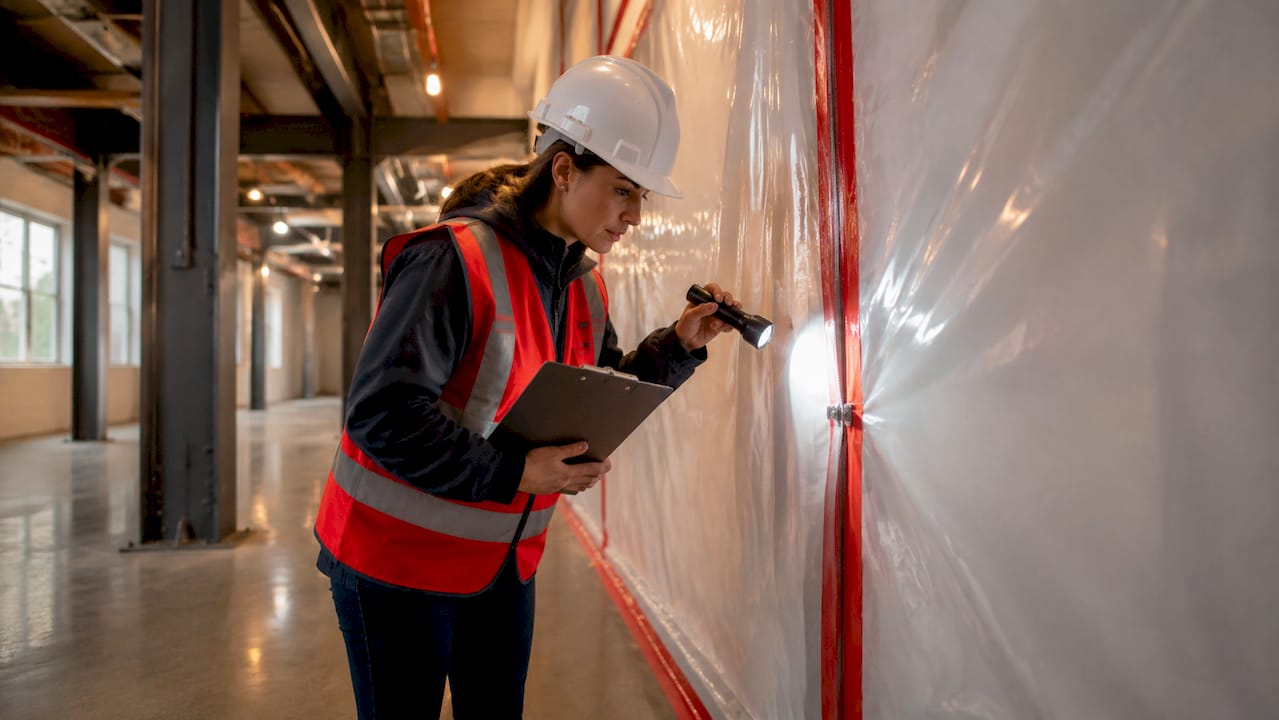
The assessor must be independent from the removal contractor. This separation is a regulatory requirement, not a preference. It removes any conflict of interest and ensures the sign-off is objective. For licensed asbestos removal projects, a licensed asbestos assessor is mandatory under Australian Work Health and Safety regulations.
Key tools and documentation required:
- A licensed asbestos removalist must complete all removal works before the assessor arrives
- The assessor uses Phase Contrast Microscopy for air fibre testing, which detects microscopic fibres invisible to the naked eye
- Site enclosure must remain fully intact during stages one through three
- Waste disposal records and removal contractor documentation must be available for review
- Environmental conditions such as temperature, humidity, and air pressure are recorded throughout
Regulatory documentation checklist:
| Document | Purpose |
|---|---|
| Asbestos removal licence | Confirms contractor is legally authorised |
| Asbestos management plan | Records location, type, and condition of asbestos |
| Air monitoring results | Scientific evidence of fibre concentrations |
| Waste disposal records | Confirms compliant disposal of removed material |
| Clearance certificate | Legal proof of safe reoccupation |
Friable asbestos removal requires licensed asbestos assessors and typically includes full air monitoring. Non-friable removal requirements can vary depending on scope and jurisdiction, but the documentation obligations remain significant regardless of asbestos type.
Pro Tip: Request copies of the removal contractor’s licence and waste disposal receipts before the assessor arrives. Missing paperwork is one of the most common causes of clearance delays.
What are the four stages of the clearance procedure?
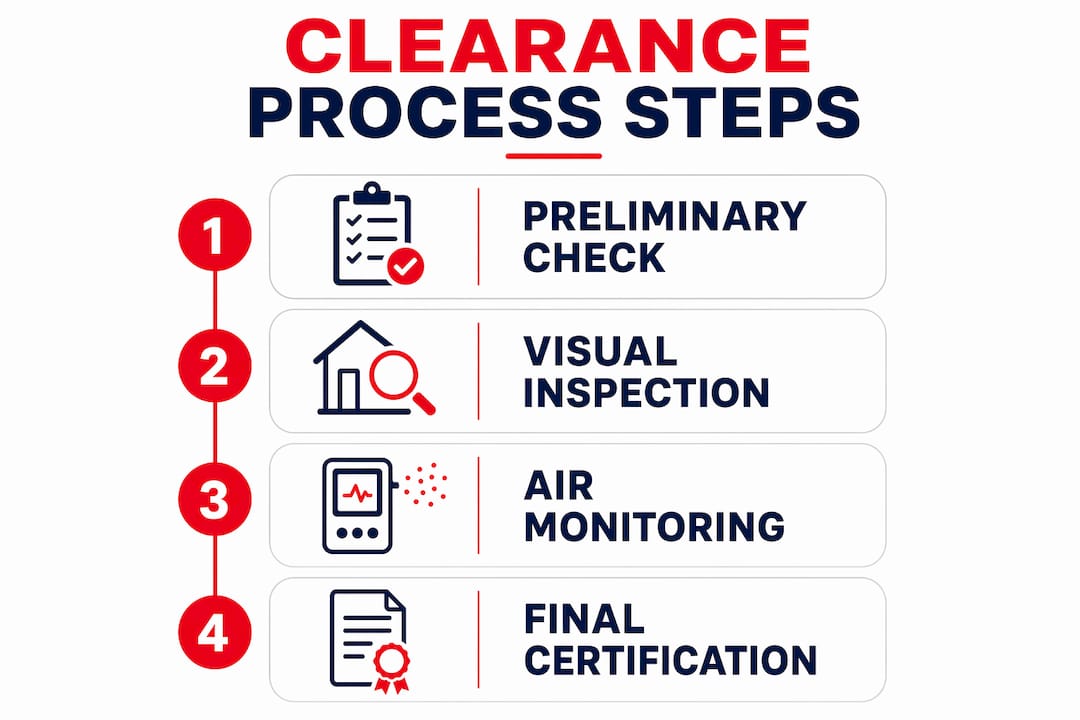
The four-stage clearance procedure is the standardised method used for licensed asbestos removal projects. Each stage must be passed before the next begins. There are no shortcuts.
-
Preliminary site check. The assessor inspects the enclosure for integrity before any internal inspection occurs. They confirm the negative air pressure unit is functioning, the enclosure has no breaches, and the removal contractor has completed all works. This stage protects the assessor and confirms the site is ready for internal inspection.
-
Detailed visual inspection. The assessor enters the enclosure and checks every surface for residual dust, debris, and asbestos fragments. Visual inspection covers high-level beams, machinery interiors, floor voids, and ledges. Fine dust in hard-to-reach areas makes this the most common point of failure. The removal contractor must re-clean and request a re-inspection if this stage fails.
-
Air monitoring and fibre testing. The assessor collects air samples while using disturbance techniques to simulate normal occupancy conditions. Results are analysed using Phase Contrast Microscopy. Fibre counts must fall below 0.01 fibres per millilitre to pass. That threshold exists because fibres at higher concentrations pose a measurable lung disease risk, including mesothelioma and asbestosis.
-
Final post-enclosure assessment. Once the enclosure is dismantled, the assessor inspects the surrounding area and transit routes for residual contamination. Any contamination found at this stage requires remediation before the certificate can be issued. This stage confirms the removal process did not spread fibres beyond the work zone.
Pro Tip: Ask your removal contractor to document their final clean with photos before calling the assessor. Visual evidence of a thorough clean reduces the chance of a stage two failure.
Stage comparison at a glance:
| Stage | What is checked | Common failure point |
|---|---|---|
| Preliminary site check | Enclosure integrity, equipment function | Enclosure breach or incomplete removal |
| Visual inspection | All surfaces for dust and debris | Fine dust on ledges and in voids |
| Air monitoring | Airborne fibre concentration | Fibres above 0.01 f/mL threshold |
| Post-enclosure assessment | Surrounding area and transit routes | Contamination outside work zone |
What does the clearance certificate actually contain?
The clearance certificate is issued only after all four stages pass. It is a legally recognised compliance document, not a simple sign-off letter.
A complete certificate includes:
- Results from each of the four stages, including pass or fail outcomes
- Air monitoring data with fibre counts and laboratory analysis
- Environmental conditions recorded during testing (temperature, humidity, air pressure)
- Methodology used, including sampling techniques and equipment
- Name and licence number of the independent qualified analyst
“Clearance is a scientific, independent verification process designed to protect public health and duty holders, not merely a visual ‘looks clean’ check.” — Confluence Environmental
The certificate is issued only by an independent qualified analyst, never the removal contractor. This independence is what gives the document its legal weight. Keep the original certificate permanently. It may be required during future property sales, insurance claims, or regulatory audits.
One critical limitation: the certificate validates safety at the moment of inspection only. Future building works, damage, or disturbance can change conditions entirely. The clearance certificate is a point-in-time verification, not a permanent guarantee. An ongoing asbestos management plan is the appropriate tool for long-term risk control.
How do you handle failures and avoid common mistakes?
Clearance failures are more common than most homeowners expect. Knowing the rules in advance prevents costly delays and legal exposure.
Common reasons a stage fails:
- Residual dust on high surfaces, inside ducts, or behind fixtures
- Enclosure breaches discovered during the preliminary check
- Air fibre counts above the 0.01 f/mL threshold after disturbance testing
- Contamination found on transit routes during the post-enclosure assessment
- Missing or incomplete removal documentation
When a stage fails, the process is clear. The assessor will not proceed to the next stage. The removal contractor must return, re-clean, and request a fresh inspection. This fail-safe sequence exists to prevent premature reoccupation. It adds time and cost, but it is non-negotiable.
The most serious mistake: allowing reoccupation before the certificate is issued. Returning occupants before clearance carries legal prosecution risk, financial penalties, and direct health consequences. As a duty holder, whether you are a homeowner or a business owner, this responsibility sits with you.
Pro Tip: Never accept verbal confirmation that a site is clear. The only valid proof of safe reoccupation is the signed, dated clearance certificate from a licensed independent assessor.
You can also review the asbestos removal permit process before works begin to understand your obligations as a duty holder from the start.
Residential vs commercial: how do requirements differ?
Clearance requirements are not identical across all project types. The asbestos type, project scale, and site classification all affect what is required.
| Project type | Asbestos type | Air monitoring required | Assessor licence required |
|---|---|---|---|
| Residential renovation | Non-friable (bonded) | Often not mandatory | Recommended, check jurisdiction |
| Residential renovation | Friable | Yes, mandatory | Yes, licensed assessor required |
| Commercial demolition | Non-friable or friable | Yes, mandatory | Yes, licensed assessor required |
| Industrial or high-risk site | Friable | Yes, full four-stage | Yes, licensed assessor required |
Friable asbestos, the loose or crumbly type found in pipe lagging, ceiling insulation, and spray coatings, carries the highest fibre release risk. It always requires a licensed removalist and a licensed assessor. Non-friable asbestos, such as fibro sheeting or floor tiles, has lower release risk but still requires careful management and, in many cases, formal clearance depending on the quantity removed.
For commercial projects, the four-stage clearance procedure applies in full, with no exceptions. The scale of commercial sites also means air monitoring must cover multiple zones, and transit routes through the building require separate assessment. Engaging the right certified professional for your project type is not optional. Mismatched credentials are a common compliance failure on residential jobs where homeowners assume any tradesperson can sign off on clearance.
Why clearance is more than a tick-box exercise
From my experience working across demolition and asbestos remediation projects in NSW, the single biggest misconception I encounter is that clearance is just about appearances. People assume that if the site looks clean, it is clean. That assumption has caused real harm.
Microscopic asbestos fibres are invisible. A site can look spotless and still fail air monitoring. The four-stage process exists precisely because human eyes are not a reliable safety instrument. The independence of the assessor is equally critical. When the same contractor who did the removal also signs off on clearance, the integrity of the process collapses. I have seen projects where this shortcut was taken, and the consequences ranged from regulatory fines to serious health investigations.
The sequential nature of the four stages is a genuine safety net. Each stage builds on the last. Skipping stage two to get to air monitoring faster does not save time. It creates liability. If contamination is found later, the absence of a proper visual inspection record becomes a legal problem for the duty holder.
The other point I want to stress is what happens after the certificate is issued. Too many property owners file the certificate and consider the matter closed. The certificate is valid only at the time of inspection. Any subsequent renovation, structural change, or damage to the building can reintroduce risk. An asbestos management plan is the document that protects you long-term. The clearance certificate is the start of responsible asbestos management, not the end of it.
— Tarek
Get compliant asbestos removal and clearance in sydney
Missiondemolition manages the full asbestos clearance certificate process for residential and commercial clients across Sydney and NSW. From licensed removal through to independent clearance certification, every stage is handled by qualified professionals who know the regulatory requirements inside out.
Whether you are renovating a home with fibro sheeting or demolishing a commercial building with friable materials, Missiondemolition coordinates the complete four-stage clearance procedure so you can reoccupy with confidence. The team works with licensed independent assessors and handles all documentation, giving you a clean compliance record from day one. For professional asbestos removal in Sydney with full clearance support, contact Missiondemolition today. The team is available 24/7 to answer your questions and get your project moving safely.
Key takeaways
The asbestos clearance certificate process requires four sequential stages conducted by an independent licensed assessor before any area can legally be reoccupied after asbestos removal.
| Point | Details |
|---|---|
| Four stages are mandatory | Preliminary check, visual inspection, air monitoring, and post-enclosure assessment must all pass in order. |
| Independence is non-negotiable | The assessor must be separate from the removal contractor to ensure an objective, legally valid sign-off. |
| Air monitoring uses PCM testing | Fibre counts must fall below 0.01 f/mL using Phase Contrast Microscopy before the certificate is issued. |
| Certificate is point-in-time only | Clearance confirms safety at the moment of inspection; an ongoing management plan is required for long-term protection. |
| Premature reoccupation carries legal risk | Allowing re-entry before the certificate is issued can result in prosecution, fines, and direct health consequences. |
FAQ
What is an asbestos clearance certificate?
An asbestos clearance certificate is a legally recognised document issued by an independent qualified assessor confirming that an area is safe for reoccupation after licensed asbestos removal. It records the results of all four clearance stages, including air monitoring data and environmental conditions.
Who can issue an asbestos clearance certificate in australia?
Only an independent licensed asbestos assessor can issue the certificate. The removal contractor cannot issue their own clearance. This separation is a regulatory requirement under Australian Work Health and Safety legislation.
What happens if a clearance stage fails?
The assessor stops the process and the removal contractor must return to re-clean the affected area. Once re-cleaning is complete, the assessor re-inspects that stage before proceeding. No stage can be skipped or bypassed.
How long does the clearance process take?
The timeline depends on site size, asbestos type, and whether any stages fail. A straightforward residential clearance can be completed in a single day. Larger commercial sites or sites with multiple failures may take several days across multiple inspection visits.
Is air monitoring always required for asbestos clearance?
Air monitoring is mandatory for all friable asbestos removal and for most commercial projects. For small-scale non-friable removal in residential settings, requirements vary by jurisdiction. Check with a licensed assessor in your state or territory to confirm what applies to your specific project.