
An asbestos removal compliance checklist is the structured set of regulatory and safety steps that every homeowner or business owner must complete before, during, and after asbestos removal work in Australia. Industry professionals call this process asbestos abatement management, and it covers everything from licences and notifications through to waste disposal and final clearance certificates. Skipping any step exposes you to serious legal liability, stop-work orders, and fines. This guide walks you through each stage of the process, flags the most common violations, and tells you exactly what documentation to keep.
What does an asbestos removal compliance checklist cover?
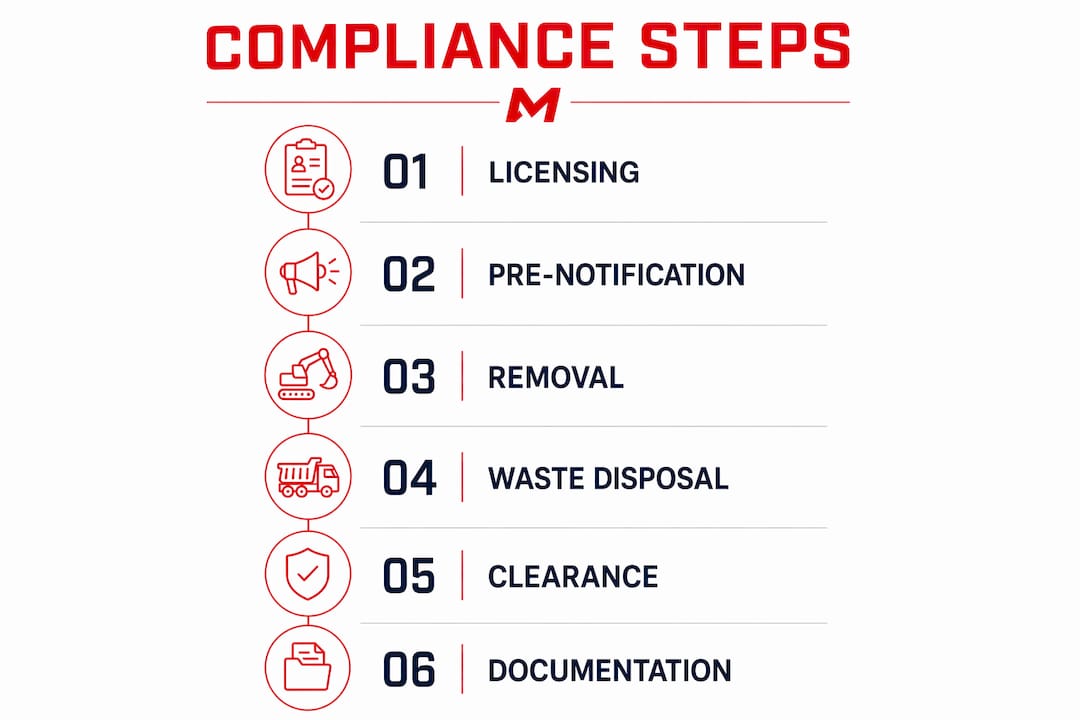
A complete asbestos removal compliance checklist addresses six distinct stages: licensing, pre-removal notification, safe removal procedures, waste management, post-removal clearance, and documentation archiving. Each stage carries its own legal obligations under Australian Work Health and Safety legislation, and failure at any one stage can invalidate the entire project. The checklist is not a suggestion. It is the difference between a legally completed project and one that attracts regulatory action.
What licences and notifications are required before removal?
Two licence classes govern asbestos removal work in Australia. A Class B licence covers non-friable (bonded) asbestos, which is the type found in most fibro homes built before 1987. A Class A licence is required for friable asbestos, which is the loose, crumbly material found in pipe lagging, ceiling insulation, and spray-on coatings. State and territory authorities, including SafeWork NSW and WorkSafe Victoria, issue both licence types. You must confirm your contractor holds the correct class for the specific material being removed.
Notification is a separate obligation and one of the most frequently missed steps. Late or missing notifications are the top cited violation in asbestos abatement audits. The notification must be submitted to the relevant authority at least 10 working days before work begins, and it must include project details such as the site address, the type and estimated quantity of asbestos, and the name of the licensed removalist. Keep a copy of the submitted notification on site throughout the project.
Verifying a contractor’s licence goes further than asking to see a card. Automated alerts for licence expiry prevent illegal work from proceeding undetected. Check that the licence covers the specific personnel who will be on site, not just the company name. Tools like the LifeSafety.ai asbestos management module allow you to track contractor accreditation status and set renewal reminders, which removes the risk of a lapsed licence derailing your project mid-way through.
Here is a pre-removal licence and notification checklist:
- Confirm contractor holds a Class A or Class B licence, as appropriate for the material type
- Verify the licence covers all personnel working on site, not just the company
- Submit notification to SafeWork NSW or your state authority at least 10 working days before work starts
- Retain a copy of the submitted notification on site
- Set an automated reminder for contractor licence renewal dates
- Confirm the contractor holds current public liability and workers compensation insurance
Pro Tip: Request a copy of the contractor’s licence directly from the issuing authority rather than relying on a document the contractor provides. This takes five minutes and removes any doubt about authenticity.
How to safely prepare and execute asbestos removal
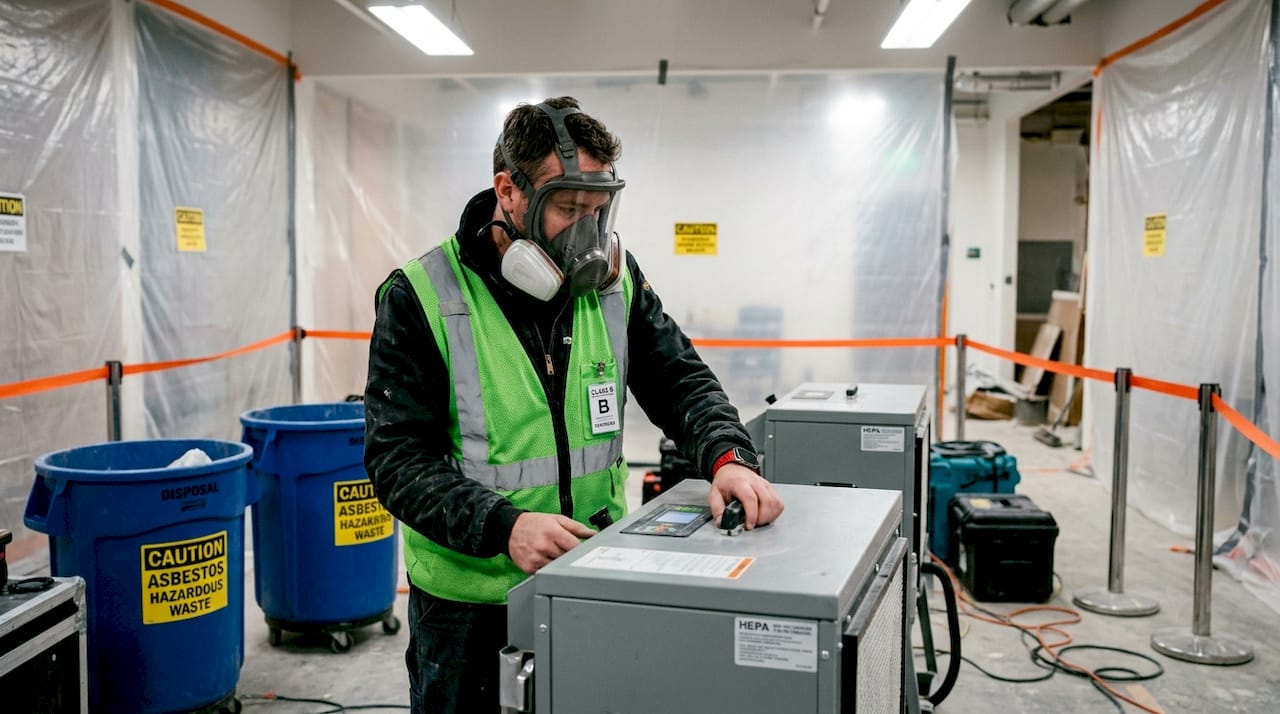
Safe removal is defined by containment, personal protective equipment (PPE), and documented method statements. Licensed removal requires strict containment with negative pressure, PPE, and continuous monitoring. Negative pressure enclosures prevent fibres from escaping the work zone into adjacent areas of the building or property. This is non-negotiable for Class A friable removal and strongly recommended for large-scale Class B work.
Follow these steps to prepare and execute removal safely:
- Establish the exclusion zone. Cordon off the work area and post asbestos warning signs at all entry points before any disturbance begins.
- Set up the negative pressure enclosure. Install polyethylene sheeting and a negative pressure unit to contain airborne fibres within the work zone.
- Confirm PPE compliance. All workers must wear P2 or P3 respirators, disposable coveralls, gloves, and eye protection. Respirators must be fit-tested, not just issued.
- Collect Risk Assessment and Method Statements (RAMS). The licensed removalist must provide a written RAMS document before work starts. This outlines every step of the removal process and the controls in place.
- Begin removal using wet methods. Wetting asbestos-containing material (ACM) before removal suppresses fibre release. Dry breaking or grinding ACM is a serious regulatory offence.
- Conduct continuous air monitoring. An independent hygienist should conduct air monitoring during removal to confirm fibre levels remain within safe limits throughout the work.
- Decontaminate before exiting the enclosure. Workers must follow a strict decontamination sequence, removing coveralls inside the enclosure and bagging them as asbestos waste before exiting.
Pro Tip: The most common procedural violation is workers exiting the enclosure without full decontamination. Brief your contractor on your expectation that decontamination records are signed off for every shift.
What are the waste management and disposal compliance requirements?
Asbestos waste disposal is a chain-of-custody process, and the legal responsibility stays with you as the property owner until it is complete. Regulated ACM must be tracked from generation through disposal using hazardous waste manifests that require dated signatures at each handoff. The manifest travels with the waste from your site to the licensed transporter and then to the approved disposal facility.
The generator’s responsibility does not end when the truck leaves your property. Your legal liability continues until the signed manifest copy returns from the disposal facility, which typically takes 35–45 days. If that signed copy never arrives, you have no proof the waste was disposed of lawfully. This is a liability that can surface years later during a property sale or insurance claim.
Key waste disposal compliance requirements include:
- All asbestos waste must be double-bagged in heavy-duty polyethylene bags, labelled with the asbestos warning symbol, and sealed before leaving the work zone
- Waste must be transported only by a licensed asbestos waste transporter
- The disposal facility must be an approved asbestos landfill, not a general waste tip
- A completed hazardous waste manifest must accompany every load
- You must retain the returned signed manifest copy in your compliance documentation archive
- Maintain a waste removal record that logs the date, quantity, transporter name, and disposal facility for every load
A cradle-to-grave documentation archive covering the register, lab tests, licences, air monitoring results, and waste manifests is your primary protection against future liability claims.
How is post-removal clearance inspection conducted?
Post-removal clearance is a four-stage assessment conducted by an independent licensed assessor, and it is the legal gateway to reoccupying the site. The four stages are visual inspection, background air monitoring, reassurance air monitoring, and final clearance certificate. The assessor must be independent of the removal contractor. Using the same company for removal and clearance is a regulatory offence in most Australian jurisdictions.
The safe fibre level threshold is below 0.01 fibres per millilitre of air. That figure is not arbitrary. It represents the point at which residual fibre concentration is considered negligible for ongoing occupant health. Air monitoring and the four-stage clearance process confirm the enclosure can be dismantled and the site reoccupied safely.
| Clearance Stage | What Happens | Who Conducts It |
|---|---|---|
| Visual inspection | Assessor checks for visible ACM debris or residue | Independent licensed assessor |
| Background air monitoring | Baseline fibre levels measured before enclosure is opened | Accredited hygienist |
| Reassurance air monitoring | Air tested after enclosure is opened to confirm no release | Accredited hygienist |
| Final clearance certificate | Written certificate issued confirming site is safe | Independent licensed assessor |
“The clearance certificate is not a formality. It is the legal document that transfers responsibility back to the property owner and confirms the site is safe for reoccupation. Without it, you have no proof the work was completed to standard.”
A common misconception is that a visual inspection alone is sufficient for clearance. It is not. All four stages are required for licensed asbestos removal work. Skipping air monitoring because the area “looks clean” is one of the most frequent compliance failures seen during property audits. Review the full asbestos removal permit process to understand how clearance fits within the broader regulatory sequence.
Key takeaways
Successful asbestos removal compliance requires a documented, stage-by-stage approach that covers licensing, notification, safe removal, waste management, and independent clearance certification.
| Point | Details |
|---|---|
| Licence class matters | Confirm your contractor holds a Class A or Class B licence matching the specific asbestos type on site. |
| Notify 10 working days early | Submit your authority notification with full project details before the deadline to avoid the top-cited violation. |
| Waste liability stays with you | Retain the signed waste manifest returned from the disposal facility to protect against future liability. |
| Four-stage clearance is mandatory | All four clearance stages, including air monitoring, are legally required before site reoccupation. |
| Documentation is your defence | A complete archive of licences, RAMS, air monitoring reports, and manifests protects you during audits and property transactions. |
What most people get wrong about asbestos compliance
Most homeowners and business owners treat asbestos removal as a physical task. Get the contractor in, remove the material, job done. That thinking is where compliance failures begin.
Successful asbestos management is primarily a compliance discipline, and the documentation trail carries as much legal weight as the physical removal itself. I have seen projects where the removal was executed perfectly but the property owner faced regulatory action because the waste manifest was never returned and filed. The physical work was invisible to the regulator. The missing paperwork was not.
The other mistake I see constantly is treating the asbestos management plan as a one-time document. The plan must be updated whenever asbestos is removed, disturbed, or new materials are identified. Failure to update the register is one of the most common findings during property audits and pre-sale inspections. A plan that was accurate in 2019 but has not been touched since is a liability, not a protection.
Licence verification down to the personnel level is also underestimated. The company may hold a valid Class A licence, but if the individual on your roof does not have current accreditation, the work is unlicensed. Check the NSW asbestos removal regulations for the specific verification steps required in your state. The few minutes this takes can save you from inheriting someone else’s compliance failure.
— Tarek
How Missiondemolition handles compliance so you do not have to
Compliance paperwork and regulatory sequencing are genuinely complex, and the cost of getting it wrong falls on you as the property owner.
Missiondemolition manages licensed asbestos removal in Sydney and across NSW with a team that holds current Class A and Class B licences, maintains up-to-date training, and handles every stage of the compliance process from notification through to final clearance certificate. If your project involves a full knockdown, the team also covers residential demolition with the same regulatory rigour. Every project includes full compliance documentation so you have a complete archive from day one. Contact Missiondemolition for a quote and a plain-English explanation of your specific compliance obligations.
FAQ
What is a class a vs class b asbestos removal licence?
A Class B licence covers non-friable (bonded) asbestos such as fibro sheeting, while a Class A licence is required for friable asbestos including pipe lagging and spray-on coatings. Your contractor must hold the class that matches the material being removed.
How far in advance must i notify authorities before asbestos removal?
Notification must be submitted to the relevant state authority at least 10 working days before regulated removal or demolition work begins. Late or missing notifications are the most frequently cited asbestos compliance violation in Australia.
Can the same company do the removal and the clearance inspection?
No. The post-removal clearance assessment must be conducted by an independent licensed assessor who has no connection to the removal contractor. Using the same company for both is a regulatory offence in most Australian jurisdictions.
What happens if my clearance air monitoring fails?
If air monitoring detects fibre levels above 0.01 fibres per millilitre, the site cannot be reoccupied. The removal contractor must re-clean the area and the four-stage clearance process restarts from the visual inspection stage.
How long do i need to keep asbestos removal records?
Retain all compliance documentation, including licences, RAMS, air monitoring reports, and signed waste manifests, indefinitely. These records protect you during property sales, insurance claims, and regulatory audits that may occur years after the project is complete.