
Demolition contractor vetting criteria are concrete benchmarks used to assess whether a contractor can deliver safe, compliant, and legally sound demolition work. Getting this wrong costs far more than a bad quote. Unlicensed operators, poor asbestos handling, and underinsured crews expose homeowners, business owners, and project managers to fines, liability claims, and serious health risks. The demolition contractor selection process requires checking verifiable documents, not just reading testimonials or accepting a low price. This guide covers every criterion that matters in 2026, from licences and insurance through to hazard management and financial red flags.
1. What are the essential demolition contractor vetting criteria to check first?
The first step in any contractor selection process is verifying credentials that can be independently confirmed. A contractor’s website may list impressive badges, but trade association memberships alone do not guarantee quality. You need to check membership numbers directly with the issuing body and confirm the scope covers demolition specifically.
The non-negotiable documents to request upfront include:
- Demolition licence specific to the Australian state where work will occur (in NSW, this is issued by SafeWork NSW)
- Public liability insurance with a minimum of $20 million cover for most residential and commercial projects
- Workers’ compensation insurance covering all on-site employees and subcontractors
- Waste carrier registration and environmental disposal permits for the relevant state
- Asbestos removal licence (Class A for friable asbestos, Class B for non-friable) where hazardous materials are present
Licensing and insurance certificates must include policy numbers and expiry dates that match the project timeline. A certificate that expired last month offers you zero protection.
Pro Tip: Ask for the insurer’s name and policy number, then call the insurer directly to confirm the policy is active. Contractors who object to this step are a red flag.
2. Which experience and portfolio criteria indicate real competence?
A contractor’s track record is the most reliable predictor of future performance. Demand examples of past projects that match your job in scale and type. A firm that has only demolished small residential sheds is not automatically qualified for a multi-storey commercial strip-out, regardless of how long they have been in business.
When reviewing a portfolio, ask these specific questions:
- Can you provide contact details for three recent clients on projects similar in size to mine?
- What demolition equipment do you own outright versus hire?
- Have you completed projects under the same local council or state authority that governs my site?
- What was the longest delay you experienced on a project, and how did you manage it?
- Do you have photographic or documented evidence of waste disposal compliance on past jobs?
Verify client references directly. Ask referees whether the contractor met the agreed timeline, stayed within budget, and handled unexpected site conditions without passing hidden costs back to the client. Vague claims about speed or cost savings without supporting evidence are a warning sign, not a selling point.
Equipment quality matters too. Well-maintained machinery reduces the risk of on-site accidents and project delays. Ask to see recent service records for excavators, demolition robots, or high-reach machines the contractor plans to use on your job.
3. How to verify safety practices and site-specific risk management
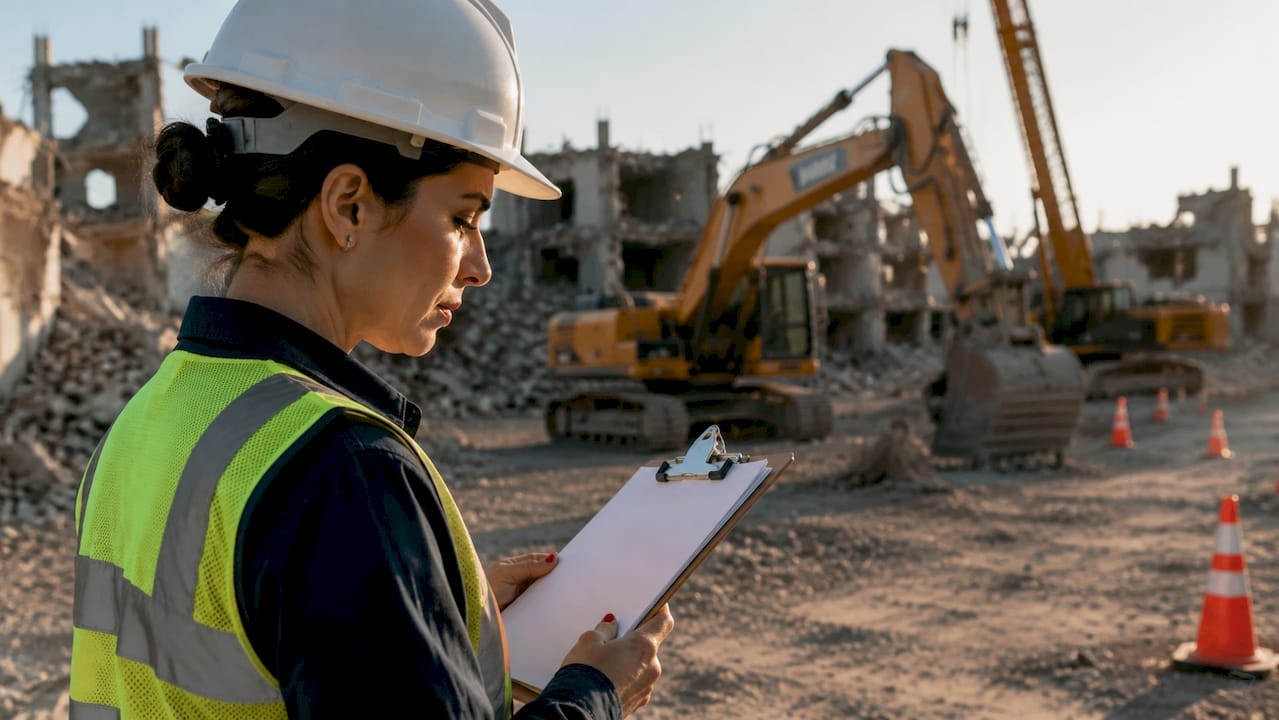
Safety culture is visible in paperwork before a single brick is touched. Contractors must provide site-specific RAMS (Risk Assessments and Method Statements) that are signed by a responsible manager, dated, and tailored to your actual site. A generic RAMS document copied from a previous job is a compliance failure, not a formality.
Key safety documents and checks to request:
- Site-specific RAMS signed by the project manager and dated within the last 30 days
- CSCS cards (or Australian equivalent training records) for every operative working on site
- Toolbox talk records showing regular safety briefings are conducted
- Supervision plan identifying who is responsible for safety on site at all times
- Incident and near-miss log from the past two years
Contractor prequalification uses the Total Recordable Incident Rate (TRIR) as a key safety metric. Ask the contractor for their TRIR figure and compare it against the industry average for demolition work. A TRIR significantly above the industry norm signals a safety culture problem.
Pro Tip: Request the name and direct contact of the site safety officer before signing any contract. If the contractor cannot name one, walk away.
4. What financial and legal vetting should you undertake?
Financial vetting protects you from contractors who win jobs they cannot afford to complete. A contractor who runs out of cash mid-project leaves you with a half-demolished structure, legal disputes, and a site that no other firm can easily take over.
| Vetting check | What to look for | Red flag |
|---|---|---|
| Insurance certificates | Policy number, expiry date, correct scope | Missing dates or generic wording |
| Bonding | Surety bond for projects above a set value | No bond offered on large contracts |
| Company financials | Trading history of at least three years | Newly registered company with no track record |
| Subcontractor list | Named subcontractors with their own insurance | Unnamed “labour hire” with no documentation |
| Bid pricing | Itemised breakdown of costs | Single lump sum with no line items |
Extremely low bids are a reliable indicator of hidden costs or non-compliance. A contractor who bids 40% below every competitor is almost certainly cutting corners on waste disposal, insurance, or site safety. That saving disappears the moment a regulator issues a fine or an injury claim lands on your desk.
“The cheapest quote is rarely the cheapest project. Unlicensed disposal of demolition waste alone can result in fines that dwarf the original contract value.” — Demolition industry guidance on contractor tendering
Check whether the contractor uses subcontractors and, if so, confirm those subcontractors carry their own insurance and licences. A head contractor’s policy does not automatically cover an uninsured subcontractor’s actions on your site.
5. How do asbestos and hazardous material protocols factor into vetting?
Asbestos management is the single most important criterion when vetting demolition contractors for any building constructed before 1990. Contractors without specific asbestos protocols pose long-term liability risks for property owners. This is not a documentation formality. Improper asbestos removal can contaminate a site for decades and expose occupants to serious health consequences.
The documents and procedures to verify include:
- Asbestos survey report completed by an accredited assessor before demolition begins
- Class A or Class B asbestos removal licence matching the type of asbestos present
- Air monitoring plan conducted by an independent hygienist during removal
- Licensed disposal facility with documented waste transfer certificates
- SafeWork NSW notification (or equivalent state authority) lodged before removal starts
| Asbestos type | Licence required | Who can remove it |
|---|---|---|
| Non-friable (bonded) | Class B licence | Licensed Class B contractor |
| Friable (loose) | Class A licence | Licensed Class A contractor only |
| Any asbestos over 10m² | Notification required | Must notify state regulator |
Independent oversight by a qualified industrial hygienist removes the conflict of interest that arises when a contractor self-certifies their own asbestos work. For any project involving friable asbestos, third-party air monitoring is not optional. You can learn more about non-compliant asbestos disposal to understand what goes wrong when this step is skipped.
6. What questions should you ask demolition contractors before signing?
The demolition contractor qualifications process is not complete until you have asked direct questions and received documented answers. Verbal assurances carry no legal weight. Every answer should be backed by a document you can keep.
The most revealing questions to ask include:
- Can you provide your current licence number so I can verify it with the state regulator?
- Who is the named project manager for my job, and what are their qualifications?
- How do you handle unexpected hazardous materials discovered during demolition?
- What is your process for notifying neighbours and the local council before work begins?
- Can you provide a written waste management plan specific to my site?
- What happens if your team causes damage to adjacent structures?
A contractor who answers these questions confidently and in writing is demonstrating the transparency that separates professional operators from unqualified ones. Verifiable certifications and project-specific RAMS signed by responsible managers are the gold standard. Marketing claims and five-star Google reviews are not substitutes for these documents.
For residential projects in Sydney, understanding what licensed demolition contractors are legally required to provide gives you a clear baseline for comparison.
Key takeaways
Effective demolition contractor vetting requires verified credentials, documented safety practices, and financial checks completed before any contract is signed.
| Point | Details |
|---|---|
| Verify credentials independently | Check licence numbers and insurance policy details directly with the issuing authority. |
| Demand site-specific RAMS | Generic safety documents are a compliance failure; insist on signed, dated, project-specific versions. |
| Treat low bids as red flags | Bids significantly below market rate usually hide non-compliance costs that fall back on you. |
| Asbestos protocols are non-negotiable | Require a licensed assessor’s survey report and independent air monitoring for any pre-1990 building. |
| Ask for documented answers | Verbal assurances carry no legal weight; every key claim must be backed by a document you retain. |
What I have learned from watching vetting go wrong
I have seen projects where the client chose a contractor based on a polished website and a low quote. The result was unlicensed asbestos removal, a stop-work order from SafeWork NSW, and a remediation bill that tripled the original contract value. The contractor had disappeared by the time the regulator arrived.
The pattern repeats because people treat vetting as a box-ticking exercise rather than a genuine risk assessment. Credentials matter more than marketing claims. A contractor who cannot produce a current licence number within 24 hours of being asked is not organised. They are unqualified.
Third-party oversight is underused in Australia, particularly on mid-sized residential projects. Hiring an independent industrial hygienist or project monitor for a large job is not an added cost. It is insurance against the contractor cutting corners when no one is watching.
Financial stability is also underrated as a vetting criterion. A contractor who wins your job on a razor-thin margin has no buffer for unexpected site conditions. When costs blow out, they either disappear or start substituting cheaper, non-compliant materials and methods.
Vetting does not end at contract signing. Check in on safety documentation, waste disposal records, and subcontractor credentials throughout the project. The best contractors welcome this scrutiny. The ones who resist it are telling you something important.
— Tarek
Why Missiondemolition meets every criterion on this list
Missiondemolition holds full licences for demolition and asbestos removal across NSW, with public liability and workers’ compensation insurance that clients can verify directly. Every project begins with a site-specific risk assessment, and asbestos surveys are completed by accredited assessors before any work starts. Missiondemolition provides itemised quotes, named project managers, and written waste management plans as standard. Client references from comparable projects are available on request. For homeowners and businesses who want a contractor that passes every vetting check without the runaround, explore Missiondemolition’s professional demolition services or get a transparent quote for your residential demolition project today.
FAQ
What is demolition contractor prequalification?
Demolition contractor prequalification is a formal risk-management process that assesses a contractor’s financial, technical, and safety capacity before they are invited to submit a price bid. It prevents unsuitable contractors from engaging on projects where they lack the qualifications or resources to deliver safely.
What licences does a demolition contractor need in NSW?
In NSW, demolition contractors must hold a current demolition licence issued by SafeWork NSW, and a Class A or Class B asbestos removal licence where hazardous materials are present. Both licences can be verified directly through the SafeWork NSW public register.
How do I spot a red flag in a demolition quote?
A single lump-sum price with no itemised breakdown is the clearest red flag. Bids significantly below every other quote usually indicate missing insurance, unlicensed waste disposal, or unqualified subcontractors.
Why is asbestos handling the most critical vetting criterion?
Asbestos mismanagement creates long-term liability for the property owner, not just the contractor. Improper removal or disposal can result in site contamination, regulatory fines, and serious health consequences that persist long after the project ends.
What is a RAMS document and why does it matter?
A RAMS document is a Risk Assessment and Method Statement. It must be site-specific, signed by the project manager, and dated before work begins. A generic or unsigned RAMS is a sign the contractor has not properly assessed the risks on your specific site.