
Legal asbestos waste disposal in Australia requires licensed removalists, authorised landfill sites, and strict compliance with state safety regulations. Getting this wrong is not just a health risk. It carries fines exceeding $50,000 and potential criminal charges. Whether you are a homeowner removing a small amount of fibro sheeting or a business managing a large commercial site, the rules are specific and non-negotiable. This guide covers the legal disposal requirements across key Australian states, how to package and transport asbestos waste correctly, and where to find authorised disposal sites near you.
What are the legal requirements to dispose asbestos waste legally in Australia?
Asbestos waste management in Australia is governed by a combination of federal safety standards and state-specific regulations. The rules differ significantly depending on where you live, how much asbestos you are removing, and whether it is friable or non-friable.
Friable vs non-friable asbestos is the first classification you need to understand. Friable asbestos crumbles easily and releases fibres into the air. Non-friable asbestos is bonded in a solid matrix, like cement sheeting or floor tiles. Friable asbestos is far more dangerous and always requires a licensed removalist.
State rules vary considerably:
- New South Wales: SafeWork NSW requires licensed removalists to notify SafeWork NSW at least 5 calendar days before starting licensed removal work. Class A licences cover friable asbestos. Class B licences cover non-friable asbestos above 10 square metres.
- Victoria: Asbestos waste must go to authorised landfill sites only. Businesses must use licensed removalists who supply Waste Tracker records for every asbestos waste movement.
- Queensland (Brisbane): Dumping asbestos in bins, public places, or resource recovery centres is illegal. Fines exceed $50,000 plus additional legal costs.
- Western Australia: WorkSafe WA allows homeowners to remove up to 10 square metres of non-friable asbestos themselves, but all waste must still go to a licensed disposal facility.
Jurisdictional differences in legal thresholds and licensing mean you must check your specific state rules before starting any removal work. Assuming the rules in one state apply in another is one of the most common and costly mistakes property owners make.
Non-compliance consequences range from on-the-spot fines to prosecution. Businesses face the steepest penalties because regulators treat commercial breaches as a greater public health risk than household incidents.
How to prepare and package asbestos waste for legal disposal
Correct packaging is not optional. Landfill operators will refuse loads that arrive improperly contained, and that refusal can leave you with asbestos waste and no legal place to put it.
Follow these steps to package asbestos waste correctly:
- Wet the material down before handling to suppress fibre release. Use a low-pressure water spray rather than a hose, which can scatter fibres.
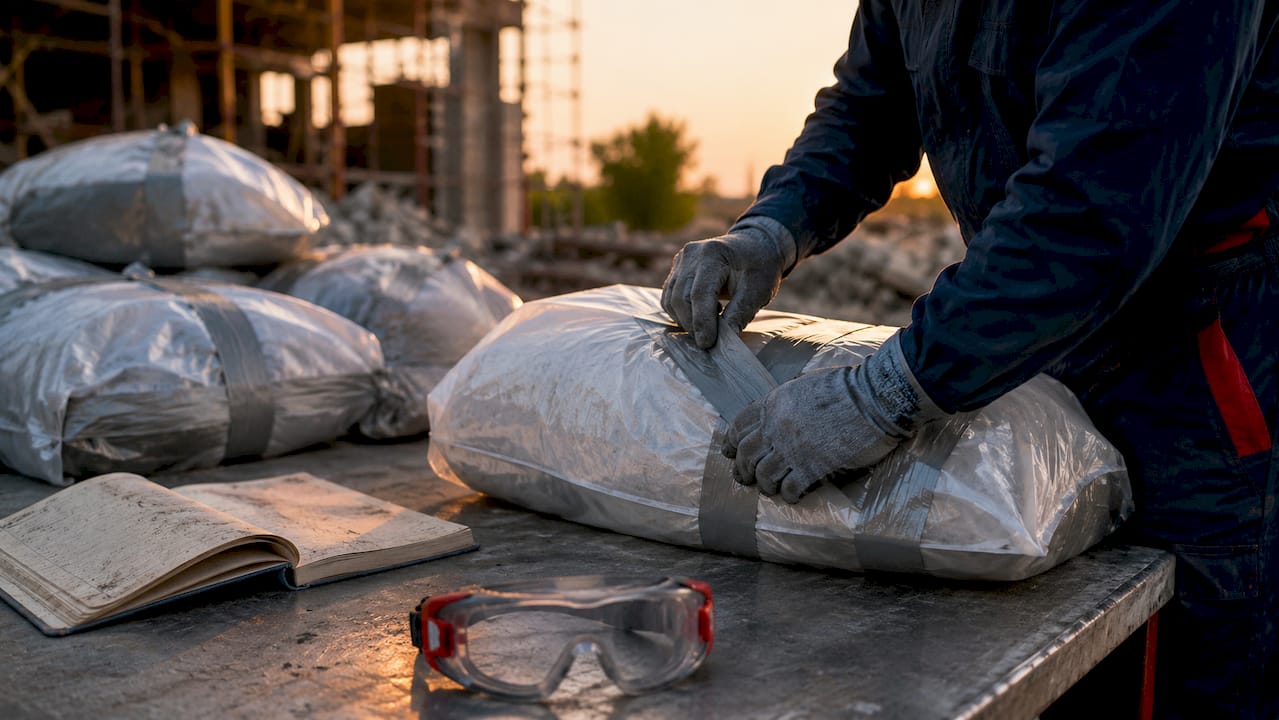
- Double-bag all waste in heavy-duty 200-micron polyethylene bags. Each bag must be sealed and free of tears before placing it inside the second bag.
- Label every bag clearly with the words “CAUTION: ASBESTOS WASTE” and your contact details. Licensed removalists must label all containment to national hazard standards before transport.
- Wrap larger sheets in 200-micron polyethylene sheeting, taped securely at all edges. Do not break sheets into smaller pieces, as this releases fibres.
- Place bagged waste in a rigid container such as a lined skip bin or sealed hard-sided container for transport to the disposal site.
- Wear the correct PPE throughout: P2 or P3 respirator, disposable coveralls, gloves, and safety glasses. Dispose of all PPE as asbestos waste after use.
Household waste and commercial waste follow the same packaging standards, but commercial operators must also maintain documentation records for each load. Businesses in Victoria, for example, must have a Waste Tracker record ready before the waste leaves the site.
Pro Tip: Never use standard household rubbish bags for asbestos waste. They tear under the weight of sheeting and will cause your load to be rejected at the gate.
Where and how to dispose asbestos waste legally in Australia
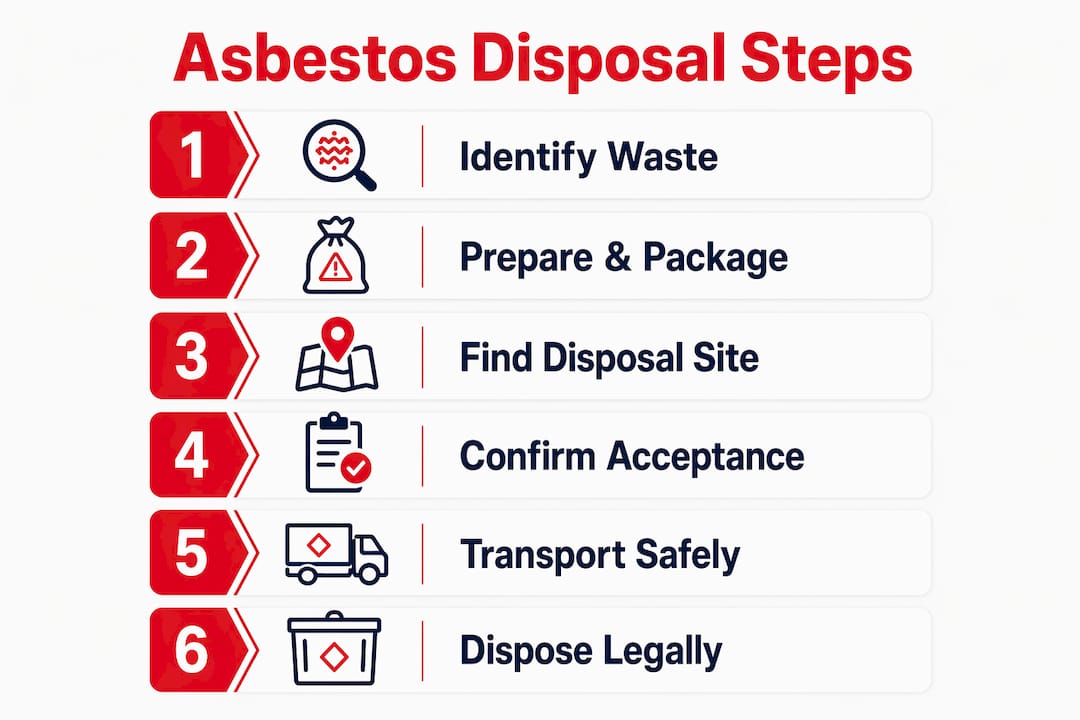
Authorised landfill sites and licensed transfer stations are the only legal destinations for asbestos waste in Australia. Not every landfill accepts asbestos. Turning up unannounced with a load is a common mistake that leads to rejection and, in some cases, illegal dumping charges when the driver disposes of the waste elsewhere out of frustration.
Finding an authorised disposal site
The Asbestos and Silica Safety and Eradication Agency (ASSEA) provides an interactive disposal site finder that maps licensed asbestos disposal facilities nationally. The tool includes location details, opening hours, and booking information. This is the fastest way to find a compliant site near you.
What to confirm before you transport
| Step | What to check |
|---|---|
| Site acceptance | Confirm the landfill accepts asbestos waste from your category (household or commercial) |
| Booking requirement | Some sites require advance bookings, especially for commercial loads |
| Packaging standards | Verify the site’s specific packaging requirements before arrival |
| Fees | Disposal fees vary by site and load size; confirm costs upfront |
| Documentation | Businesses must bring Waste Tracker records or equivalent state documentation |
EPA Victoria notes that authorised landfill acceptance varies for household and commercial asbestos waste, and confirming before disposal is required. This is not a suggestion. Arriving without confirmation risks rejection and leaves you legally exposed.
Pro Tip: Call the landfill the day before transport, not the morning of. Some sites have limited asbestos acceptance windows and fill their daily quota early.
Transport rules
Asbestos waste must travel in a covered vehicle or enclosed trailer. The load must be secured so no material can shift or fall during transit. Businesses transporting asbestos waste in Victoria must have a Waste Tracker record for the movement. NSW has equivalent documentation requirements for licensed removalists. Personal vehicles can be used for small household quantities, but the vehicle must be thoroughly cleaned after transport.
Common mistakes and legal risks when disposing of asbestos waste
Even well-meaning property owners face heavy penalties by using incorrect disposal methods. The law does not distinguish between deliberate dumping and negligent disposal. Both attract the same enforcement response.
The most common mistakes include:
- Using general waste bins: Asbestos waste placed in household or commercial bins contaminates the entire load and exposes waste workers to fibres. This is illegal in every Australian state.
- Taking waste to council recovery centres: Most council resource recovery centres do not accept asbestos. Brisbane City Council explicitly prohibits asbestos at its recovery centres and imposes fines exceeding $50,000 for breaches.
- Assuming local landfills accept asbestos: Many do not. Assuming acceptance without confirmation is a documented cause of illegal dumping incidents.
- Skipping licensed removalist requirements: Removing friable asbestos or large quantities of non-friable asbestos without a licensed contractor is an offence in every state.
- Failing to notify regulators: In NSW, failing to notify SafeWork NSW 5 days before licensed removal work begins is a separate offence from the removal itself.
“Disposal compliance depends more on sending asbestos waste to authorised locations than on safe packaging alone. Proper landfill approvals and licences are non-negotiable.” — EPA Victoria
To verify a licensed removalist, check the relevant state regulator’s public register. In NSW, use the SafeWork NSW licence register. In Victoria, check the WorkSafe Victoria register. For the NSW asbestos removal regulations in full detail, including licence classes and notification duties, Missiondemolition has published a complete 2026 guide.
If you find illegally dumped asbestos, do not touch it. Contact your local council or the relevant state EPA. Most states have dedicated illegal dumping hotlines and will arrange safe remediation.
Key takeaways
Legal asbestos disposal in Australia requires authorised landfill sites, correct packaging, and licensed removalists for friable or large-scale non-friable work.
| Point | Details |
|---|---|
| State rules differ significantly | Check your specific state’s thresholds and licensing requirements before starting any removal. |
| Packaging must meet national standards | Use double-bagged 200-micron polyethylene, labelled clearly, before transport. |
| Confirm landfill acceptance first | Contact the disposal site before transporting waste to avoid rejection and illegal dumping risk. |
| Businesses need Waste Tracker records | Victorian businesses must obtain Waste Tracker documentation from licensed removalists for every load. |
| Illegal disposal carries severe penalties | Fines exceed $50,000 in Queensland, with additional legal costs for non-compliant disposal. |
What I’ve learned from years of asbestos disposal work in Australia
The single biggest compliance failure I see is not recklessness. It is overconfidence. Property owners who have done a small renovation before assume the rules they vaguely remember still apply, or that they apply the same way in every state. They do not.
NSW’s notification system, for instance, catches people off guard. The 5-day pre-notification requirement to SafeWork NSW is not just paperwork. It exists so regulators can track removal activity and respond if something goes wrong. Skipping it because you think the job is small enough is exactly the kind of reasoning that leads to enforcement action.
The Waste Tracker system in Victoria is another area where I see businesses stumble. Requesting and verifying those records before a job is complete is not the removalist’s job alone. As the property owner or site manager, you share responsibility for ensuring the documentation exists. If a licensed removalist cannot produce a Waste Tracker record, that is a red flag worth acting on before the waste leaves your site.
My practical advice is this: use the ASSEA disposal site finder before you book a removalist, not after. Knowing which authorised sites are near you, what they accept, and whether they require bookings shapes the entire logistics plan. Trying to sort this out on the day of removal is how loads end up sitting in the back of a ute overnight.
For large quantities or any friable asbestos, use a licensed professional every time. The cost of getting it wrong, financially and in terms of health risk to your workers and neighbours, is far higher than the cost of doing it right.
— Tarek
Asbestos removal and disposal services by Missiondemolition
Handling asbestos waste correctly takes more than good intentions. It takes the right licences, the right documentation, and direct relationships with authorised disposal facilities.
Missiondemolition provides fully licensed asbestos removal in Sydney and across NSW, managing every step from safe removal and correct packaging through to authorised disposal. The team holds the required licences for both friable and non-friable asbestos work and handles all SafeWork NSW notifications on your behalf. For property owners and businesses who need broader site clearance, Missiondemolition also offers professional demolition services that include compliant asbestos remediation as part of the full scope. Contact Missiondemolition for a quote and get the job done without the legal risk.
FAQ
What types of asbestos require a licensed removalist in Australia?
Friable asbestos always requires a licensed removalist in every Australian state. Non-friable asbestos above 10 square metres also requires a licensed contractor in most states, including NSW and Victoria.
Can I take asbestos waste to my local tip?
Not all tips accept asbestos waste. You must contact the facility beforehand to confirm acceptance, packaging requirements, and booking needs. Use the ASSEA disposal site finder to locate authorised sites near you.
What are the fines for illegal asbestos disposal in Australia?
Fines vary by state but are severe. In Brisbane, dumping asbestos in bins or public places carries fines exceeding $50,000 plus additional legal costs. Other states impose comparable penalties.
What is a Waste Tracker record and do I need one?
A Waste Tracker record is a mandatory document in Victoria that licensed removalists must provide for every asbestos waste movement. Businesses disposing of asbestos in Victoria must obtain and retain this record for lawful compliance.
How do I verify that a removalist is properly licensed?
Check the public licence register maintained by your state regulator. In NSW, use the SafeWork NSW register. In Victoria, check WorkSafe Victoria. A licensed removalist should be able to provide their licence number on request. For a full asbestos removal compliance checklist, Missiondemolition has published a detailed 2026 reference guide.